Legal Insights
Reading Time: 9 min.
DAOs, or Decentralized Autonomous Organizations, are reshaping the landscape of blockchain projects with their innovative approach to governance and operations. However, as these organizations gain popularity, it becomes increasingly important to shield founders and members from potential liabilities while ensuring the DAO can function effectively in the traditional business world. Establishing a legal wrapper around the DAO is the most effective way to provide it with a distinct legal personality, allowing it to engage in contracts, hire employees, and interact with external entities without compromising the safety and interests of its participants.
This article delves into the best jurisdictions for DAO legal wrappers in 2024, exploring the legal, regulatory, and operational aspects that make each jurisdiction suitable for different types of DAOs.
Key Considerations for Selecting a DAO Legal Wrapper
The formation structure of a DAO should be tailored to meet its specific needs, as there is no one-size-fits-all solution or universally optimal jurisdiction for establishing a DAO legal wrapper. Each jurisdiction offers distinct features and benefits, making it more or less suitable depending on the specific operational requirements and goals of the DAO. The choice of jurisdiction should therefore be guided by the particular needs of the DAO, ensuring that its legal structure aligns with its governance model, regulatory considerations, and overall mission.
Some of the key considerations while selecting a jurisdiction are as follows:
- Level of Decentralization.
The desired level of decentralization within a DAO significantly influences the choice of jurisdiction, as certain jurisdictions may impose restrictions on governance structures that are incompatible with a highly decentralized model. - Regulatory Compliance.
The level of regulatory compliance a DAO is willing to adhere to plays a crucial role in selecting an appropriate jurisdiction. Some jurisdictions offer more lenient regulatory environments, allowing for greater flexibility. - Privacy and Disclosure.
Depending on the DAO’s objectives, the level of required disclosures can vary. Certain jurisdictions emphasize privacy, providing legal structures that reduce the requirement for public disclosures. - Taxation.
Jurisdictions with favorable tax regimes can help DAOs optimize their financial performance, retaining more resources for their core activities. - Corporate Governance.
Some jurisdictions offer tailored frameworks that accommodate the unique governance models of DAOs, while others may impose rigid structures that limit operational flexibility.
Below is a brief overview of jurisdictions commonly used to establish DAO legal wrappers.
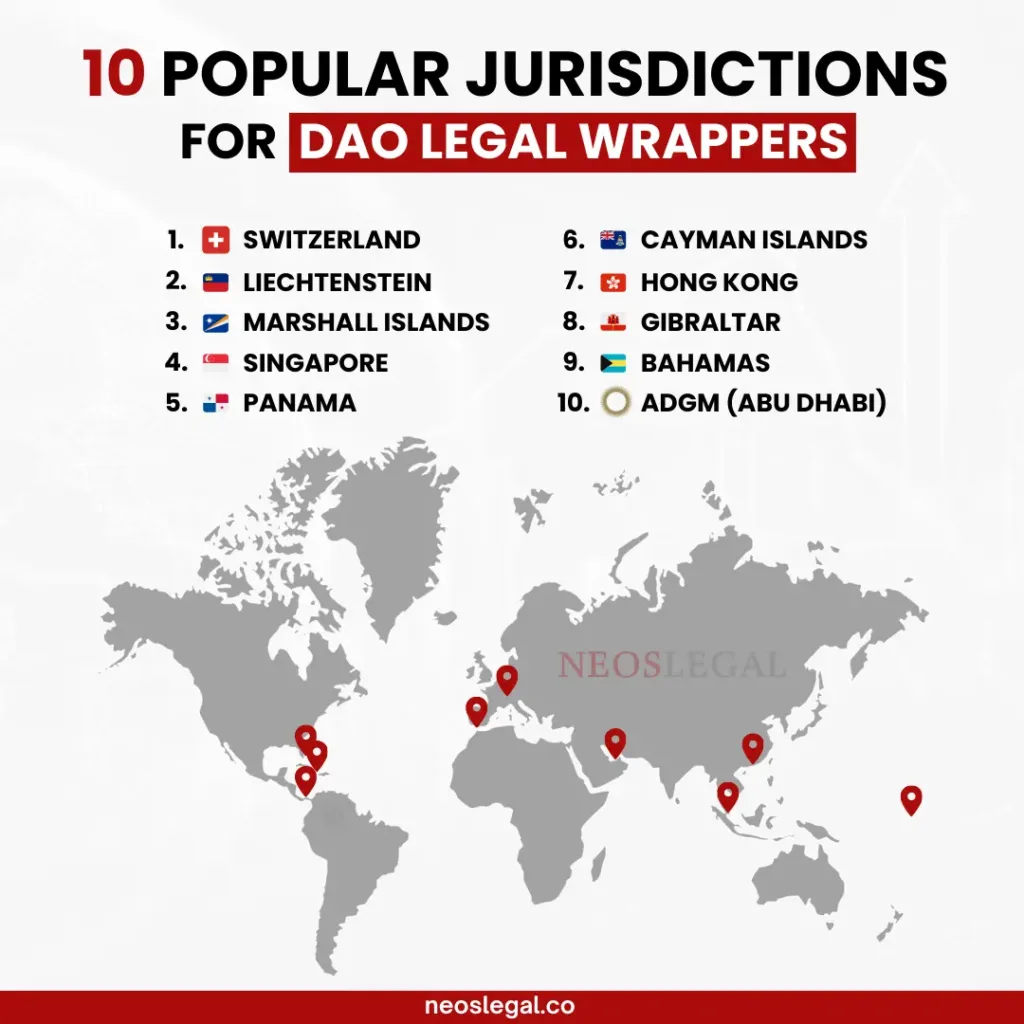
Switzerland: Foundation and Association Models
Switzerland has served as a leading jurisdiction for DAOs, offering two primary legal structures: the Foundation and the Association.
The Swiss Foundation is well-suited for DAOs that prioritize asset protection and alignment with decentralized principles, offering a rigid structure with a fixed purpose determined by the founder. However, this rigidity, coupled with high incorporation costs and a lengthy setup process, can be limiting, particularly as the foundation is restricted to non-profit activities.
In contrast, the Swiss Association provides greater flexibility, allowing DAOs to customize their governance structures, distribute executive powers, and quickly incorporate without the need for a minimum capital requirement. While the Association also limits activities to non-profit purposes and can be expensive to set up, its adaptability and member-driven nature make it an attractive option for DAOs seeking a more customizable legal framework.
Both structures benefit from Switzerland’s stable and trusted legal environment, limited liability for members, and a reputation for financial security, making them popular choices for DAOs.
Liechtenstein Foundation
The Liechtenstein Foundation is a legally and economically independent entity, making it a popular choice for DAOs, particularly those involved in both for-profit and non-profit activities. This structure offers a high degree of anonymity for beneficiaries and allows for the fast incorporation of the DAO. The foundation operates under the governance of at least two council members, one of whom must be an EU national. While the incorporation process is relatively quick, the high costs and significant capital requirements may deter smaller DAOs or those with limited initial funding.
Marshall Islands: DAO LLC
The Marshall Islands has emerged as a leading jurisdiction with its innovative DAO LLC structure, recognized under the Decentralized Autonomous Organizations Act of 2022. This legal framework provides DAOs with formal recognition, allowing them to adopt tailored governance tools and operational structures. One of the standout features of the Marshall Islands DAO LLC is the ability to establish Series LLCs, which function similarly to cells in a cell company, providing DAOs with significant operational flexibility. The jurisdiction also offers broad legal protection and the ability to conduct public token sales without the need for permits, provided the tokens do not offer financial benefits beyond potential economic gains. However, the setup process can be lengthy, and the regulatory environment is complex with limited anonymity and mandatory annual reporting.
Singapore: Company Limited by Guarantee
Despite the lack of specific DAO regulations, Singapore is a leading financial hub with a sophisticated legal system, making it an attractive jurisdiction for DAOs. In Singapore, DAOs often rely on the Company Limited by Guarantee (CLG) structure, which is well-suited for non-profit organizations. The CLG offers limited liability to its members, fast incorporation processes, and low government fees, making it a cost-effective option for DAOs. However, the absence of DAO-specific laws means that DAOs in Singapore must operate within the constraints of traditional corporate structures. Additionally, the 17% corporate income tax and the requirement to file annual returns add to the operational burden for DAOs established in Singapore.
Panama: Foundation
Panama is emerging as a favorable jurisdiction for DAOs, particularly those seeking strong asset protection, confidentiality, and tax benefits. The Panama Foundation allows DAOs to own investments and engage in global commercial activities, providing a flexible legal framework. One of the key advantages of the Panama Foundation is its ability to offer robust confidentiality, with legal mechanisms in place to protect assets from seizure, even by the government. The relatively low incorporation costs and the fast setup process make Panama an attractive option for DAOs, although the requirement for multiple board members and limited banking options pose challenges.
Cayman Islands: Foundation
The Cayman Islands offers a Foundation structure that functions similarly to civil law foundations or common law trusts, providing DAOs with separate legal personality and limited liability. This structure is particularly advantageous for DAOs that wish to establish legal personality without the need for shareholders or members. The Cayman Foundation is flexible, allowing for the inclusion of digital assets and DAO-associated governance or utility tokens within its constitution. Despite these benefits, the Cayman Islands imposes strict KYC standards and complex regulations, which may be cumbersome for DAOs with limited resources. Additionally, the foundation must comply with the Virtual Asset Service Providers Act.
Hong Kong: Company Limited by Guarantee
Hong Kong is another jurisdiction that offers a sophisticated legal environment for DAOs, particularly through the Company Limited by Guarantee (CLG) structure. The CLG is ideal for DAOs due to its alignment with the non-profit nature of many DAOs, as it does not allow profit distribution to members. The legal system in Hong Kong is well-developed, providing a reliable framework for DAO operations. However, the setup process can take 4-6 weeks, and the structure requires multiple overseers, including at least two directors and a local company secretary, which can add to the administrative burden. Despite these challenges, Hong Kong’s position as a global financial hub and its non-taxable income for activities conducted outside the jurisdiction make it a compelling option for DAOs.
Gibraltar: Foundation
Gibraltar has been an early adopter of blockchain technology and offers a robust regulatory framework for DAOs. The structure, provides DAOs with a separate legal personality, allowing them to hold and manage assets independently. This structure enables DAOs to perform crucial tasks such as development activities and treasury management while maintaining regulatory compliance. Gibraltar’s status as a tier-1 jurisdiction and the absence of restrictions on commercial activities further enhance its attractiveness. However, the foundation is subject to a 12.5% tax, and the requirement for multiple overseers, including a licensed trustee, adds to the complexity of setting up and maintaining a DAO in Gibraltar.
Bahamas: Foundation
The Bahamas Foundation offers a unique combination of benefits for DAOs, including no taxes, strong confidentiality provisions, and fast formation times. The Bahamas considers a foundation to be a legal entity with the capacity to own assets in its own name, making it an attractive option for DAOs focused on asset protection. The jurisdiction’s legal framework ensures that the names of the settlor, beneficiaries, council members, and protector are not included in public records, providing high anonymity. However, the minimum capital requirement and the need for a local registered agent are notable challenges. Additionally, the Bahamas’ high level of anonymity could pose sanctions risks, which DAOs must consider carefully.
Abu Dhabi Global Market (ADGM): DLT Foundations
In November 2023, the Abu Dhabi Global Market (ADGM) introduced the Distributed Ledger Technology (DLT) Foundations Regulations, providing a comprehensive legal framework for DAOs and blockchain-based entities. This new legislative structure is designed to accommodate the unique needs of the blockchain industry, allowing DAOs to operate, issue utility tokens, and maintain compliance with regulatory standards. The ADGM DLT Foundation is particularly suited for Layer 1 Protocols, offering a specialized governance mechanism within its charter for managing tokens. However, the high incorporation costs, paid-up capital requirement, and the relatively lengthy incorporation process may be prohibitive for some DAOs. Additionally, the foundations are not as flexible as other legal structures, which may limit their suitability for certain types of DAOs.
___
Selecting the optimal jurisdiction for a DAO legal wrapper requires careful consideration of various factors, including decentralization, regulatory environment, privacy concerns, taxation, and corporate governance needs. Each jurisdiction offers unique benefits and challenges, making it essential to align the choice with the specific operational goals and long-term vision of the DAO. Given the complexities involved, tailored legal advice should be sought to determine the most suitable jurisdiction for your DAO.
Need expert, personalized guidance? Book a Strategy call with the UAE Crypto Lawyer now.