Events
RWA tokenization in Dubai 2026 has shifted from concept to execution. VARA's updated virtual assets issuance rulebook is the first end-to-end framework globally that governs issuance, custody and trading in one place (VARA, 2025). DMCC now hosts close to 800 licensed crypto companies, the largest concentration in any single jurisdiction. This article is the full record of the RWA Summit Dubai panel where Irina Heaver, UAE Crypto Lawyer and Founder of NeosLegal, recommended by Lexology as the UAE's leading blockchain lawyer, sat with VARA, DMCC and CoinMENA to explain how to actually launch in Dubai in 2026.
Quick Summary
RWA tokenization in Dubai 2026 has shifted from concept to execution. VARA's updated virtual assets issuance rulebook is the first end-to-end framework globally that governs issuance, custody and trading in one place (VARA, 2025). DMCC now hosts close to 800 licensed crypto companies, the largest concentration in any single jurisdiction. This article is the full record of the RWA Summit Dubai panel where Irina Heaver, UAE Crypto Lawyer and Founder of NeosLegal, recommended by Lexology as the UAE's leading blockchain lawyer, sat with VARA, DMCC and CoinMENA to explain how to actually launch in Dubai in 2026.
Key Takeaways
- VARA's updated token issuance rulebook is the framework covering issuance, custody and trading end-to-end.
- DMCC now hosts close to 800 crypto companies, including licensed VASPs, the largest cluster of any free zone worldwide.
- 50% of VARA's active regulatory pilots are real world asset tokenization projects (VARA, 2026).
- CoinMENA grew from USD 10 to 20 million monthly volume into hundreds of millions after VARA licensing, with 85% of flow now corporate.
- Tokenization succeeds when it solves a real problem (USDT in emerging markets), not when it copies an existing asset (tokenized NVIDIA shares).
- NeosLegal has structured 300+ Web3 companies since 2016 globally and across VARA, DMCC, ADGM, DIFC and CMA.
What Happened, Where, and Who Spoke
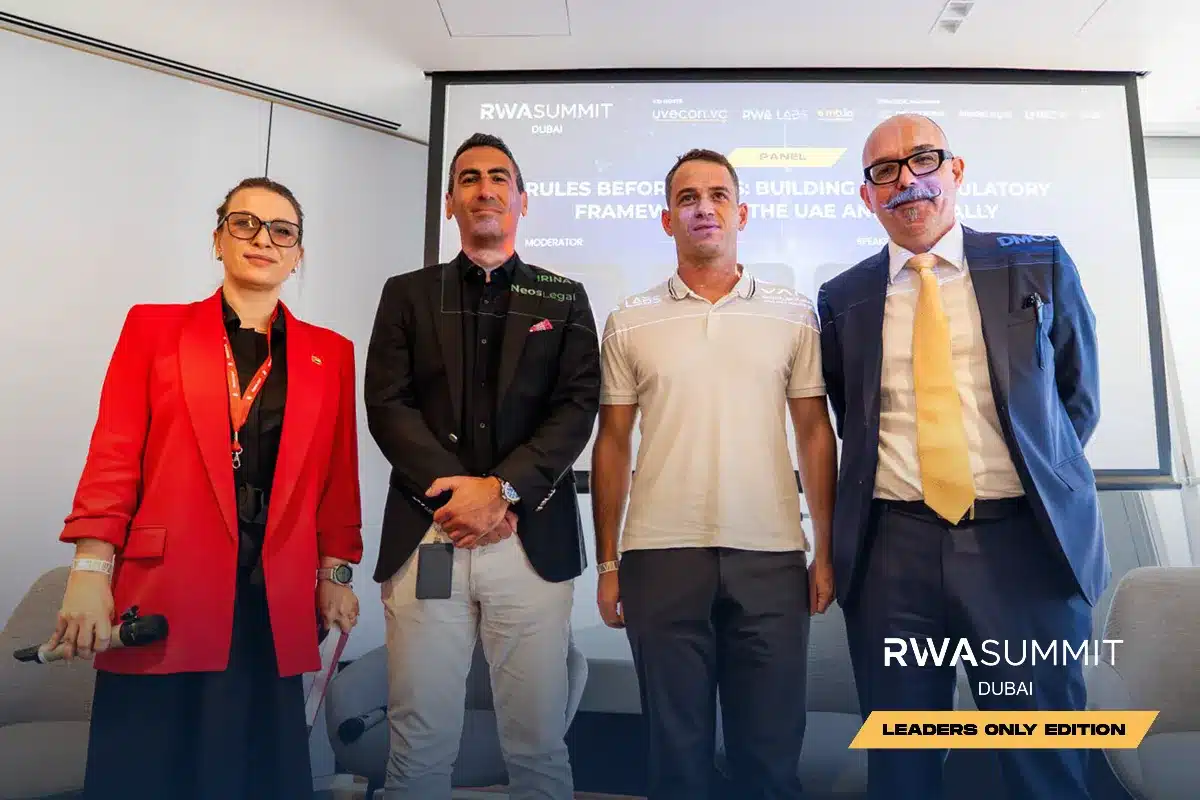
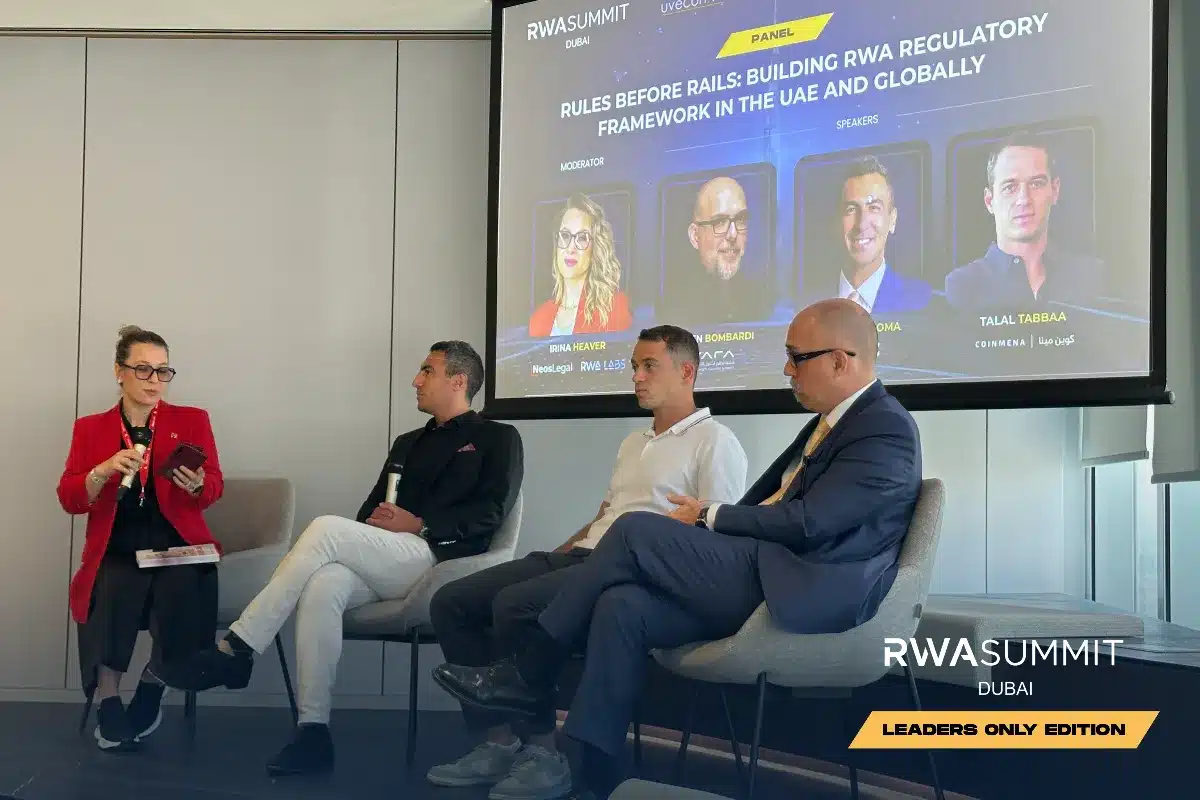
The RWA Tokenization panel took place at the RWA Summit Dubai, Leaders Only Edition, hosted at the DMCC Uptown Tower in Dubai. The summit was organised by NeosLegal and RWALabs.io to bring together the regulator, the free zone, the licensed exchanges and dealers and asset owners into a single conversation about how RWA tokenization actually works in Dubai in 2026.
The Moderator
Irina Heaver, UAE Crypto Lawyer and Founder of NeosLegal, recommended by Lexology as the UAE's leading blockchain lawyer, contributor to the Chambers and Partners Blockchain and Virtual Assets Global Practice Guide, and winner of the Oath Middle East Legal Award for Technology Legal Team of the Year. Irina has been working on UAE crypto matters since 2016, when she was, in her own words, "trying to convince people to tokenize gold" inside DMCC before the regulations existed.
The Speakers
Ruben Bombardi, general Counsel & Director of Regulatory Enablement at VARA. Ruben personally drafted the RWA tokenization framework and sits at the centre of VARA's pilot programme. An investment banking lawyer by trade, he is responsible for shaping how the regulator engages with new operating models before they are codified into rules.
Talal Tabbaa, Co-founder and CEO of CoinMENA, the VARA-regulated broker dealer. Talal has tried to register virtual asset companies in the United States, Russia, Switzerland, Bahrain and Jordan. CoinMENA grew its monthly volume from USD 10 to 20 million into hundreds of millions after becoming VARA-regulated, and 85% of the firm's volume is now corporate.
Belal Jassoma, Director of Ecosystems at DMCC. Belal runs the largest crypto cluster in the world by company count, with close to 800 licensed firms inside the DMCC Crypto Centre. He oversees onboarding, ecosystem services, and the infrastructure that connects DMCC's traditional commodity traders to its digital asset operators.
Why This Panel Matters
This is the only public panel in 2026 where the regulator, the free zone, the licensed broker dealer and the legal counsel all spoke in the same room about RWA tokenization. The discussion covered the policy logic behind VARA's rulebook, the commercial reality of operating under it, the ecosystem that makes Dubai workable for founders, and the cases where tokenization actually solves a problem versus the cases where it does not.
Why VARA Built an RWA Framework That No Other Regulator Has
VARA built a dedicated RWA tokenization framework because institutional adoption of tokenized assets does not happen without legal enforceability. Two or three previous waves of ICOs ended with investors losing money in non-regulated structures. Without a framework that makes the white paper legally enforceable against the issuer, consumer protection cannot be guaranteed, and institutional capital does not move.
Ruben Bombardi explained the policy logic plainly. The regulatory framework focuses on three things: sufficient disclosure in the white paper calibrated to investor type, legal enforceability so that what is written in the paper is what goes into the token, and infrastructure that lets institutional players adopt tokenized assets to solve real problems in traditional finance.
Tokenizing an asset is the easy part. As Ruben put it on the panel, anyone can write 10 lines of code and issue a token on a blockchain. The real challenge is creating enough volume in the transition from the real world version to the tokenized version that infrastructure providers come into the picture and gravitational pull moves trading on-chain. That is what VARA's pilot programme is designed to enable.
50% of VARA's active pilots are RWA tokenization projects. Ruben confirmed on the panel that he has seen "everything under the sun" in tokenization white papers, including capital market products like ETFs, private stocks and government bonds.
"Every regulator in the world has approached virtual asset as an extension of financial services regulation. There is an implicit conflict of interest there, because you're effectively regulating something that undermines the ecosystem that pays the bill. Dubai moved very early on with an approach of seeing the value rather than seeing the threat. We are not here to defend the banking industry. We are here to enable this new sector to thrive."
Ruben Bombardi, General Counsel & Director of Regulatory Enablement, VARA
Why Being VARA-Regulated Is a Commercial Advantage, Not a Burden
Being VARA-regulated is the single biggest commercial advantage available to a UAE crypto company in 2026. Talal Tabbaa was direct about it on the panel: CoinMENA went from USD 10 to 20 million in monthly volume to hundreds of millions after becoming VARA-regulated. 85% of CoinMENA's volume is now corporate, not retail. No CFO and no risk officer at a serious corporate signs off on a counterparty in a jurisdiction without a meaningful licence.
Talal compared his attempts to register virtual asset companies elsewhere. Central banks in the United States, Russia, Switzerland, Bahrain and Jordan all tried to fit virtual asset businesses into the categories they already understood: bank, exchange house, payment service provider. None of those definitions work for a digital asset broker dealer. VARA is the first regulator globally that built a framework specifically for virtual assets rather than retrofitting financial services rules.
The regulator is strict on the things that matter. AML and CFT compliance, investor protection, custody and disclosure are non-negotiable. On product classification, where there is genuine grey area between security, ARVA (asset-referenced virtual asset) and quasi-security, VARA is more flexible and engages on operating models case by case. This is the practical meaning of principle-based regulation: the rule sets the goal, the licensee proposes the path, and the regulator engages.
"There is no scenario where you go to a VASP and ask how regulation is, and they tell you it is amazing. As a profit-oriented business, my goal is shareholder value. But VARA gives you things no one else in the world has. We reshaped CoinMENA after being regulated. It took us from a company doing 10 to 20 million dollars a month to hundreds of millions. That would not have been possible without VARA."
Talal Tabbaa, Co-founder and CEO, CoinMENA
How DMCC Became the Largest Crypto Ecosystem in the World
DMCC built the largest crypto ecosystem in the world by combining three things in sequence: early conviction, ecosystem building, and regulatory alignment. Belal Jassoma described the timeline on the panel. DMCC started supporting crypto companies before the sector was mainstream, signalling to the market that the free zone was open. Then it built the licensing framework. Then it built the service provider network around it.
The result is a cluster of close to 800 licensed crypto companies inside the DMCC Crypto Centre, which is closing in on Switzerland's Crypto Valley as the largest crypto hub by company count globally. The growth over the last three to four years is, in Irina's words on the panel, "absolutely incredible."
The reason DMCC works for RWA tokenization specifically is that the same business district hosts the underlying real economy. Diamond traders, gold dealers, commodity desks and SMEs sitting on illiquid physical assets are all inside the same free zone as the crypto operators who can tokenize those assets. The MOU signed between DMCC and VARA in 2024 created the infrastructure layer that confirms the commodity exists, confirms the title, and confirms the custody, which gives any tokenized commodity project a defensible audit trail.
"Crypto companies here are not just going to work in isolation. They have access to the real economy, where the assets are actually residing. That is what RWA is, connecting the digital asset to the real economy."
Belal Jassoma, Director of Ecosystems, DMCC
Rules Versus Rails: The Real Sequencing Question
Talal pushed back on the panel against the idea that rules come before rails. His point: Bitcoin and USDT would never have existed if their creators had asked permission first. Rails come first. Rules come next. Then they get scaled together. Sovereign wealth funds and institutional desks will not interact with permissionless rails directly, but they will interact with regulated infrastructure built on top of those rails.
This is the precise sequence VARA operates on. The technology exists. The traditional financial sector wants exposure. The regulator's job is to build the rules that let regulated capital touch those rails without taking on systemic or consumer protection risk.
Ruben added the historical context. The first regulatory reaction to Bitcoin was fear. Between 2017 and 2019 there were repeated waves of bans and prohibitions globally because the technology was designed to disintermediate the banking system that most central banks and securities regulators are tasked with protecting. Dubai took the opposite view. The leadership saw value rather than threat, and built an entity (VARA) whose mandate is enablement of a new sector, not defence of an old one.
Where RWA Tokenization Actually Solves a Problem
RWA tokenization solves a problem when it gives access to something the user could not access before. It does not solve a problem when it merely puts an existing tradable asset on-chain. Talal made this distinction sharply on the panel.
USDT works because someone in Egypt, Pakistan or India cannot easily access US dollars. USDT is digital dollars. There is a real, painful problem and tokenization removes the friction. By contrast, a tokenized NVIDIA share is, today, a "solution looking for a problem." Anyone in a country with brokerage access can already buy NVIDIA. Anyone without dollar access cannot meaningfully use a tokenized NVIDIA share either.
The RWA categories where Belal sees DMCC adding the most value are:
- Illiquid physical commodities held by real traders inside the free zone (diamonds, large silver bars, specialty metals) where tokenization unlocks liquidity that simply does not exist today.
- SME asset-backed financing where small and medium businesses can tokenize commodities or receivables they already hold to access financing they cannot get from banks.
- Commodity-backed instruments built on the DMCC and VARA infrastructure that confirms commodity existence, title and custody.
The category where Ruben sees the most creativity is conduit tokenization. He cited the tokenization of marine wildlife adoption as an example of using token mechanics to fund volunteering and donation programmes that traditional structures cannot support efficiently. Tokenization, in his framing, is a settlement layer for any economic relationship, not just for trading.
"Dubai has just solved the reasons why STO failed. With the release of the updated virtual assets issuance rulebook by VARA, RWA tokenization has shifted from concept to execution. We now have a framework that covers issuance, custody and trading end-to-end, and an ecosystem of 800 licensed companies sitting next to the real economy. Founders who get this right in 2026 will define the next decade."
Irina Heaver, UAE Crypto Lawyer & Founder of NeosLegal | Recommended by Lexology as the UAE's leading blockchain lawyer
What Industry Still Gets Wrong About Dubai
The most common misconception about Dubai, according to Belal, is that the market is less regulated than Europe or the United States. It is not. The rules are clear, the principles are strict, and the licensing standards are real. What Dubai offers that other jurisdictions do not is regulatory clarity combined with engagement. The rules are written, but the regulator will sit with you to discuss your operating model.
Ruben confirmed this on the panel. VARA's rules are designed as principle-based rules because the environment moves too fast for prescriptive regulation. The two-year drafting cycle that other regulators use produces rules that are obsolete on publication. VARA writes principles, regulates by common sense, and engages with knowledgeable counsel to find workable paths to the same compliance outcome.
The other thing founders get wrong is sequencing. Many arrive in Dubai having already incorporated, already minted a token, already designed a commercial model, and only then look for legal counsel. By that point the structuring options have collapsed. The right sequence is: legal architecture and token design first, then incorporation, then issuance.
Frequently Asked Questions
What is the VARA RWA tokenization framework?
The VARA RWA tokenization framework is the updated virtual assets issuance rulebook published by Dubai's Virtual Assets Regulatory Authority. It is the first end-to-end regulatory framework globally that governs issuance, custody and trading of tokenized real world assets in a single rulebook. It covers white paper disclosure requirements, legal enforceability of token terms against issuers, AML and CFT compliance, custody standards, and trading conditions.
Why is Dubai better for RWA tokenization than other jurisdictions?
Dubai is the only jurisdiction in 2026 where regulatory clarity, ecosystem density and capital formation converge in one place. VARA is the first crypto-native regulator (it does not also regulate financial services, removing the implicit conflict of interest other regulators face). DMCC hosts close to 800 licensed crypto companies inside a free zone that also contains the underlying commodity and trade economy. ADGM and DIFC offer additional pathways for institutional structures. Most other jurisdictions retrofit financial services rules onto digital assets, which produces friction at every step.
What real world assets can actually be tokenized under VARA rules?
Under VARA's framework you can tokenize physical commodities (gold, silver, diamonds), capital market products (equities, ETFs, bonds), real estate, SME-held receivables and inventory, and asset-referenced virtual assets (ARVAs) backed by reserves. The DMCC and VARA infrastructure adds an additional verification layer for commodity-backed tokens that confirms existence, title and custody. Conduit tokenization for adoption, donation and impact programmes is also permitted under the framework.
How much does it cost to launch an RWA tokenization project in Dubai?
The total cost to launch a VARA-regulated RWA tokenization project in Dubai in 2026 typically falls between AED 500,000 and AED 1.2 million in Year 1, depending on token classification, licence category, and whether the issuer also requires custody or trading permissions. This includes legal structuring, white paper drafting, VARA application fees, free zone licensing, capital deposit requirements and ongoing compliance setup. NeosLegal provides a fixed-scope cost breakdown during the initial strategy call.
Why work with NeosLegal on a UAE RWA tokenization project?
NeosLegal has structured over 300 Web3 and crypto projects globally and across VARA, DMCC, ADGM, DIFC and CMA since 2016. Founder Irina Heaver is recommended by Lexology as the UAE's leading blockchain lawyer, a contributor to the Chambers and Partners Blockchain and Virtual Assets Global Practice Guide, and the Oath Middle East Legal Award winner for Technology Legal Team of the Year.
Full Panel Transcript
RWA Tokenization Panel, RWA Summit Dubai, Leaders Only Edition
DMCC Uptown Tower, Dubai
Speakers: Irina Heaver (NeosLegal, moderator), Ruben Bombardi (VARA), Talal Tabbaa (CoinMENA), Belal Jassoma (DMCC)
Duration: approximately 40 minutes
Read the full transcript
Irina Heaver: I would like to welcome Ruben from VARA. The individual has personally written the RWA tokenization rules. I would like to welcome Talal, thank you very much, from CoinMENA, the regulated broker dealer, and of course Belal, who is the head of the ecosystems at the DMCC. Basically, what can we do without the ecosystem? Not much. Please, welcome.
So, the backdrop seems to be not backdropping, but that is okay.
Belal Jassoma: Maybe we can just keep the Uptown Tower.
Irina Heaver: In 2018, we said everything will be tokenized and traded on-chain. We were not wrong. We were just early. I remember the conversations I had here in DMCC with Ahmed bin Sulayem and his team. Paul was there. And I was trying to convince them to tokenize gold. People were looking at me like, who is this lady? Why does she keep talking to us about crypto?
And here we are, just five, six years later. We have the regulations. They are working. Things are being tokenized. We have a massive ecosystem. DMCC Crypto Centre has built the largest ecosystem footprint. What are we now, 750 companies?
Belal Jassoma: Close to 800.
Irina Heaver: Close to 800 companies, which is the largest. Have you overtaken the Swiss Crypto Valley yet?
Belal Jassoma: Just about. We don't know.
Irina Heaver: And the growth that we had over the last three, four years is just absolutely incredible. The main driver of this is the regulations, in my mind. Of course I am a lawyer, so I am a little bit biased, but in my mind it is the clear regulations, something that can be followed by regulated entities like CoinMENA. And it is a fantastic ecosystem, because there is nothing we can do without an ecosystem. You are not a warrior if you are by yourself. We need a room full of warriors, which we have here.
Ruben, if we may start with you, please. Talking about the RWA framework that you personally drafted, what was the thinking strategy around it? What is the policy? What is the Dubai overarching policy? Why do we need it? Nobody else has it. Why do we have it?
Ruben Bombardi: Firstly, thank you to Yury and Irina for inviting us to this wonderful event. Also to Anton for his very good keynote and presentations.
Going to the regulatory framework. We felt the need of having a clear regulatory framework around tokenization, especially the tokenization of real world assets, because we saw the waves of ICOs, we saw the waves of attempted tokenization of assets, and we saw what happened in the past historically.
There have been two or three waves of ICOs, and most of the time they ended in a non-regulated way with a lot of investors losing money. We strongly believe that tokenization is, as you say, inevitable. Everything will be tokenized. I generally believe that is the case. And like you, I believed maybe too early when the first waves were coming.
But we believe that tokenization can be done properly and should be done properly to enable real adoption and real scale. The reason behind the RWA tokenization framework is that institutional adoption will not happen unless there is a clear legal and regulatory framework around it.
It is a combination of factors. We always have consumer protection in mind whenever we think about regulations. There is an element of ensuring that the disclosure in the white papers is sufficient for any investor, depending on the type of investor you are addressing. The legal enforceability of those arrangements and those disclosures is another important factor. We have seen in the past, it is very easy. You can draft a white paper in five minutes, and now with AI you see white papers generated literally at the click of a button. But if what you write in that white paper is not what goes in the token, and someone cannot hold you responsible for what you write in the white paper, then consumer protection cannot be guaranteed.
At the same time, we want to enable institutional adoption. We have seen tokenization of securities. Real tokenization will happen when this type of institution can operate and adopt tokenized assets to solve existing problems in the traditional finance world. Tokenization of government bonds, ETFs, equities, and so forth.
The next step, which we are working towards now, is that tokenizing assets in and of itself is not really going to be sufficient. You made the point about your experience in exchange, market making, high frequency trading. Tokenizing an asset is very easy. I can tokenize whatever you want. I write 10 lines of code, create a blockchain. Nobody is going to use it. It is not going to create liquidity to the underlying asset.
The real end game is creating enough volume in the transition from real world to on-chain to then have infrastructure coming into the picture. Going back to Anton's slides, the infrastructure piece is very, very important. I am not going to mention names, but the names were significant. When the assets end up embedded into the infrastructure and institutional adoption comes inside infrastructure, that is when we will see the paradigm shift.
Irina Heaver: So how important is that piece from a regulatory perspective? Are you facilitating that in any way from a policy point of view?
Ruben Bombardi: It is critical. In my role of regulatory enablement, I am always trying to see where the ecosystem needs to evolve and where the regulation needs to follow the enablement of the ecosystem.
I am very, very focused on real world asset tokenization. In fact, I will say that 50% of my pilots are around tokenization of real world assets. In terms of numbers, maybe I have some other pilots that are systemically bigger in one pilot, but in aggregation I literally see, and we were talking about it before, I have seen everything under the sun in terms of tokenizing whatever anyone can think about. I have seen it.
I am also seeing the attempt to tokenize capital market products, and that is what is going to be very important at this point in time. ETFs, tokenizing stocks, tokenizing private stocks. You have seen the DLD pilot we are referring to, which is one of our pilots at VARA. We want to create a set of modules in terms of real world assets that are tokenized that will enable the real gravitational pull to move the trading from the real world asset itself to the tokenized version. That is what will bring infrastructure and volume. We are also working on some bigger projects around infrastructure development.
Irina Heaver: That is very important. Infrastructure is very important. And part of that infrastructure is being regulated and working under these rules. Talal, would you tell us if you believe those rules are workable, or they are too strict? Because that is what we hear complaining about 24-7. This is way too strict, and this is too unworkable.
Talal Tabbaa: Trying to get me in trouble now.
Irina Heaver: You seem to be not only working, you seem to be thriving. I am recording you.
Talal Tabbaa: There are enough cameras here for this to be on the record.
Irina Heaver: So you are not only working, you are thriving. What is the secret juice that you have that nobody else seems to be getting?
Talal Tabbaa: You need to have the right team in place. The reality is, there is no scenario where you go to a VASP and ask them how regulation is and they tell you, oh, it is amazing, it is exactly what we wanted.
That is the reality of it. As a business, my goal is profit and shareholder value. Part of that requires me to maintain a good licence and ensure that I am fully compliant with VARA, but if I can, as a profit-oriented business, it would be naive for you not to do that.
It is very important to be transparent that CEOs and businesses, their main goal is profit. We are not charities. We are profit-oriented businesses that serve our shareholders. But at the same time, we need to comply with VARA's regulations. The reality is VARA is strict in some things, but it gives you things that no one else in the world has.
You mentioned earlier that no one has really done this. I have tried to register virtual asset companies in the United States, Russia, Switzerland, Bahrain and Jordan, many countries. I have dealt with central banks, commodities centres, securities exchanges. Nothing that is virtual assets. If I go to the central bank, the way the central bank deals with this is they look at us as a bank, exchange house or PSP, because those are the definitions they have been working with.
It is refreshing and amazing to see that VARA is doing this, and it is a learning process. This is the thing I really appreciated with VARA. They acknowledge that not 100% of everything is clear. There are things that are going to be figured out as you go. But there are certain things that, as a VASP, you cannot have leeway in. AML, investor protection. Those are things they are very strict on. But when it comes to, for example, whether something is a security or a quasi-security or an ARVA, there is slightly more flexibility on that side.
With VARA-regulated companies, using reverse solicitation, you are able to serve a bigger audience. We have completely reshaped our company after being regulated by VARA. It took us from a company that does, I do not know, 10 to 20 million dollars a month, to doing hundreds of millions. That would not have been possible without VARA's regulations.
Irina Heaver: So you are basically saying being regulated is the advantage you have on the market, and it also increases your flow volumes.
Talal Tabbaa: Yes, of course. To start off with, when we started it was a retail company. Now 85% of our volume is corporate. There is no way I can convince these corporates and their CFOs and their risk officers of a jurisdiction otherwise.
Irina Heaver: I think that is one of the things people are just starting to grasp, that being regulated is actually an advantage. The Wild West, we are not seeing that much anymore. And another massive advantage is being part of the ecosystem, where those corporates are, where commodities companies are, where you can gather people like this in an auditorium.
So Belal, how did you manage to do this? How did you build the biggest, most densely populated ecosystem in the world?
Belal Jassoma: First of all, thank you for choosing DMCC to do the summit. Fantastic organization so far.
I would say a combination of three things. Early conviction, ecosystem building, and regulatory alignment. To elaborate. DMCC started supporting crypto companies before the sector became mainstream. We showed the world that we are open to the sector. We see the opportunity in it. And we did not just build the licensing framework for those companies, we built a complete ecosystem and started offering services and access to providers to help those companies grow.
Fast forward to today, we are leading a crypto hub with almost 800 companies. And thriving. A lot of nice projects, a lot of exciting things happening.
At the same time, it was the UAE's advantage. The UAE offers a lot of ease of doing business and a tax-friendly environment. Always forward-thinking, positioned as a crypto-friendly jurisdiction. It really helped us to have regulators like VARA, the first and probably still the only crypto-native and crypto-dedicated regulator that helped us craft the rules.
We have a complete business district that has access to commodities and trade and other sectors. Crypto companies are not just going to work in isolation here. They have access to the real economy. And I think that is what RWA is, right. Connecting the digital asset to the real economy, where the assets are actually residing.
Irina Heaver: We work internationally in 60 plus jurisdictions. I cannot think of one place where it actually happens. It does happen at DMCC by real businesses, real commodities, real asset owners. And then you mix it with the crypto crazy people and the AI even crazier people, and you get a really interesting mixture for success.
Belal Jassoma: Reflecting on what Ruben was saying as well, regulating the infrastructure or the blockchain layer is the easier part when it comes to RWA. Here, you have got a physical asset and a digital asset. You have to regulate them both together. There are a lot of questions that need to be answered around who owns the asset, who has the title, where is it stored, how is it managed, insured. How is the redemption process managed? Is there a redemption process? All those questions do not get answered without having the right infrastructure.
Talal Tabbaa: Looking at the title of what we are supposed to talk about. It says rules before rails. I actually disagree with that. Rules do not come before rails. If you look at Bitcoin, USDT and so on, none of them would have worked if they went to the government and said, hey, I am looking to create a private form of money to compete with your money. I do not think they would have done that.
Irina Heaver: You can join the next panel, too.
Talal Tabbaa: But I guess this is before scaling rails. Meaning, you are not going to have sovereign wealth funds interacting with Bitcoin and USDT and other types directly. Rails come first, rules come, and then they are scaled.
Irina Heaver: Yes, the rules and the rails are scaled together, which is the right approach. Imagine if anybody came for Bitcoin to be permissioned. And that reminds me of the 2017, 2018, 2019 wave of bans and prohibitions. Remember how many times Bitcoin, ICOs and crypto were banned and prohibited. I stopped counting after number 10 or 20.
That also tells me, Ruben, that governments generally regulate out of fear, or out of the unknown. If I do not know what it is, it is easier for me to ban it. Here is the ban, do not touch it. It has not helped, but that is how they do it. But Dubai has a difference. Regulate from opportunity. For me, what I see as an outsider, and I had the privilege of interviewing VARA at least five times, I believe that VARA, or the government of Dubai, saw the opportunity and decided, let us not let this opportunity go. Let us build rules around it and bring more of that.
Can you tell us more from the policy perspective, why is Dubai acting differently from everybody else?
Ruben Bombardi: I think you summarized it perfectly, especially the divide between the approach of the leadership in this country, which has been very enlightened in many decisions in the past, but particularly in the decision around virtual assets, making the UAE and Dubai the global hub for regulated virtual assets.
Likewise, I even remember before the 2017, 2018 ICO waves, I remember stumbling across the Bitcoin white paper fairly early on. I started to discuss it internally. I am an investment banking lawyer by trade. Back in those days, everyone was terrified at best, and very vocal and adamant against this new technology without understanding what it could mean.
Part of the reason was that regulators globally were seeing this type of asset as a threat. If you think about it, this technology was born to disintermediate financial services institutions from the banking system. It was born out of the Lehman crisis, when Satoshi Nakamoto thought about the fact that the banking system does not work. You have all these intermediaries, they end up failing, people lose money. So it was designed to disrupt the status quo.
As a regulator, every regulator in the world has approached virtual assets as an extension of financial services regulation. I am not going to name names, but literally every single regulator that regulates virtual assets also regulates financial services. There is an implicit conflict of interest there, because you are effectively regulating something that undermines, I do not want to say what pays the bill, but your ecosystem. So there is going to be a natural tendency to, A, reject something that is perceived as a threat, and B, it removes control. As a regulator, as a central bank, you cannot control monetary policy if monetary policy is disseminated in a network of decentralized nodes. You can no longer control your market.
The first reaction back in the day was fear. Ban everything. Do not allow any of this technology to thrive. Some regulators have moved on. A lot of regulators have adopted. But the difference was that Dubai moved very early on with an approach of seeing the value rather than seeing the threat.
Dubai and the UAE are a global hub when it comes to financial services. Rather than taking that defensive approach, leadership was enlightened to understand that this is going to be where financial services are going. Whether you like it or not, it is a matter of time. The rails we are discussing here will be the financial service rails in two, five, ten years, I do not know how many, but that is where financial services are going.
Rather than postponing, fighting it, and trying to avoid the inevitable, the leadership here understood this is where the future is going to go. And they positioned themselves at the forefront, making the decision to establish an entity like VARA that can trailblaze. Because I do not really care, I obviously care about the financial sector, I care about the system, I care about systemic risk, but I am not here to defend the banking industry. I am here to enable this new sector to thrive and bring the value it can bring to the global ecosystem.
Irina Heaver: So talking about all that new asset class, all that existing asset class being tokenized and hitting the rails. Talal, what would happen if that hits the exchanges at that volume? Do we have the rails to handle it, or there is still more work to be done?
Talal Tabbaa: I do not know if you have compared the user experience of crypto exchanges versus banks, but I am more biased towards crypto exchanges, so if that distinction was not clear.
Today you already have it. The reality is USDT today is a better way of moving dollars than any other way in the world. This is no longer theory. Anyone that has used USDT to move money around can compare it to going from point A to point B on a horse or in a car. One is clearly superior to the other.
From that standpoint, I do think we are ready. Obviously I am looking at it from a crypto-native standpoint. But let us look at the other side. If you have banks like Standard Chartered that have not only gone into crypto, it means you can actually keep your assets in a bank that has a balance sheet incomparable to crypto companies like us.
So I do think the infrastructure is ready. But one of the issues I have with tokenized assets is, it is a solution looking for a problem. Whereas with USDT, there was a real problem. You cannot access dollars in Egypt, Pakistan, India, et cetera. USDT is digital dollars.
NVIDIA shares, all right, cool. I can buy them, inshallah, soon on CoinMENA and VARA. But basically, tokenized NVIDIA shares for someone in Egypt who cannot access dollars at all. So I think the next wave of RWA growth needs to come when it is actually solving problems that are material, not just nice to have, which is what tokenized NVIDIA shares would be at this stage in my mind.
Irina Heaver: Fair enough. So Belal, from the ecosystem point of view, what are the coolest projects you see coming into the RWA space? Are they solving a problem? Or are they nice to have? What are the most interesting ones you have seen lately, that you can talk about?
Belal Jassoma: I can be biased by saying the coolest project is tokenizing the world's largest silver bar, which is a world record winner, going to happen very soon. We have a webinar talking about it next week for those who want to join.
But back to your point about solving a problem. Yes, maybe tokenizing shares is not really solving a big problem. But when you look at physical assets that are large and not as liquid, we have a lot of traders in DMCC sitting on diamonds and other assets that they can access liquidity for by being able to tokenize them. At the same time, SMEs can probably get more financing by tokenizing some of the assets they have and putting them on the market.
That is what we really want to focus on. The infrastructure we built at DMCC is purely to enable commodity-backed tokenization. That is building on the MOU we signed with VARA last year. The infrastructure has a system to actually confirm the commodity being there, confirm the title, confirm the custody. That gives a lot of trust and security on the projects.
Irina Heaver: So to close out the panel, I will ask the spiciest questions I can. If you feel shy about answering, you can pass the mic, but we will do a spicy round.
Ruben, how many lawyers have called you and complained about the VARA regulations?
Ruben Bombardi: Many.
Irina Heaver: Why?
Ruben Bombardi: The regulations are too clear, and they are complaining that they are not able to bill enough. They are asking me to write unclear regulations and taking away their billable hours.
Talal Tabbaa: Was that good enough?
Ruben Bombardi: Every lawyer, I think, in Dubai now knows that I am very protective of the rules. Even my colleagues, every now and again, someone comes and asks, why did you do that? It does not make sense.
Irina Heaver: And Ruben, you will testify, I am the one who comes and asks, can we relax here a little bit? Can we allow that? I am always lobbying for the industry.
Ruben Bombardi: Sorry, I am taking some time here, but I think it is important for people to understand the philosophy of VARA. The rules are designed as principle-based rules because we decided to do it that way. We know that this is such a fast-moving environment that regulating the old school way, by enforcement or being too rigid, doing what other regulators are doing in other jurisdictions where it takes you two years to draft a regulation, by the time it comes out it is obsolete.
We regulate by principles, and we regulate also by common sense. We do not want to set out regulations that are impossible to comply with. We want to set out regulations that achieve their purpose, which is consumer protection, market integrity, AML, FATF, and so on. But we are also open to discuss various operating models. In fact, it has happened many times, because I do not know every single operating model possible under the sun. Maybe tomorrow there is going to be a new operating model that changes the view we have about a particular product or rule. So we are always very happy to engage, especially with knowledgeable lawyers like yourselves, to discuss the requirements and see whether you can achieve the same output. Ultimately, we are goal-oriented. It is not just the rules by ticking the box. If you tell me what output you need to achieve, I am sure we will find a way around it.
Irina Heaver: That is a great call to action to the industry. If you have something that you believe can be explained or worked around, this is a great call to action. Ruben, we will write it down.
Talal, what is the craziest thing you saw in the last cycle, where people were trying to list on CoinMENA and they were convinced this would work?
Talal Tabbaa: We get a lot of crazy requests. But I want to combine crazy and serious. If someone is just sending an email, we have had people trying to tokenize their parents.
Irina Heaver: I will buy one.
Talal Tabbaa: That is not something we are going to take seriously. To try and unlock liquidity that way is not necessarily a good idea. But we had one serious request, to tokenize a very popular football player in Europe. Compliance told me, Talal, you are going to go into a different type of industry. You do not want to go into that. But basically, to me it was exciting, because that football player has a big contract. If he scores a specific amount of goals, he gets to share the revenue with the token holders. Eventually it was scrapped, because, you know, you do not want to buy humans, even if there is branding on it.
So the parents one, obviously we do not respond to that. The football player one was the crazy serious one.
Irina Heaver: I am actually curious to know, what is the weirdest RWA request that came to VARA?
Ruben Bombardi: Whatever you can think about, we have seen a white paper for it. One of my favourites was the tokenization of turtles. So it is not really that you buy a turtle and sell a turtle. It is more like adoption of marine wildlife for the purpose of supporting it.
Irina Heaver: I actually quite like it. Turtles, bees, dolphins.
Ruben Bombardi: Yes, exactly. Various ways to look at assets. There is obviously gold, shares, whatever, but tokenization can also become a conduit for other initiatives, like volunteering, donations for this type of project. I am not the creative one. The creative ones are you on the floor. You can think about using tokenization in new ways to unlock old problems or to make life better for people.
Irina Heaver: Belal, you are the ultimate authority. If I come and want to register a really crazy client of mine, you are the one who approves that registration. Tell us what you have rejected lately, a really bizarre concept that you thought, no, we are not doing this. Anything you can share?
Belal Jassoma: I am getting a mental block right now. Anyone from my team can help.
Irina Heaver: Or you are so welcoming that pretty much everybody is welcome and then we figure it out.
Belal Jassoma: Since we are not a regulator, it is kind of hard for us to reject people at our level. If they pass all the compliance checks and everything, they can come and set up. But obviously, we can go back, me and my team, and talk about it and say, look, this is not going to work out. Eventually it does not.
Irina Heaver: Okay, easier question. Tokenized gold or Bitcoin? You can take both.
What would you guys take? Bitcoin, gold. No? You want nothing? Okay. I had some to share, but if nobody is playing.
Ruben, the most BS RWA buzzword that is currently circulating, that you want to ban from circulation?
Ruben Bombardi: I am not a banning type of person. I cannot think of anything off the top of my head that is so wild or so BS that I would say, do not mention it to me. Obviously, anything that is illegal or immoral, and to be honest, we have seen some of those as well, I am not even going to engage. But generally speaking, I am the wonky ideas person. So I am normally the one who comes up with, why do we not do this that is impossible and stupid? But I like the idea anyway. Let us try it. So I will welcome all kinds of non-BS.
Irina Heaver: Another call to action for everybody. Talal, which tokenized asset will dominate the next cycle?
Talal Tabbaa: USDT, probably.
Irina Heaver: I think it is already dominating, no? Can it dominate more?
Talal Tabbaa: Yes. I think we have a Tether gentleman here, so you can dominate harder. The reality is, I do not know how that is going to go. But on the hype word, I think agentic assets is something that is overused, and I have yet to see an agentic tokenized asset. I am still very bullish on USDT's growth, especially after the GENIUS Act and the dollar shortage in emerging markets.
Ruben Bombardi: I love the agentic economy, agentic AI concept. I think that is where the frontier is at the moment. The agentic economy is going to become significant in the next four to five years. I would say by 2030 it will be very interesting. From a legal point of view, it blows my mind.
Talal Tabbaa: One final point from my side. For RWAs to properly scale, you need financial institutions to understand that the technology and security and hacking risk is minimal. As new LLMs come out, there will be two types of crypto assets. One that gets hacked and drained because their smart contracts were not good enough. And the ones that survive those new LLMs coming through, which will be the best test of trust for the long term.
Irina Heaver: Belal, last question for you before we wrap up. One thing that the industry still gets wrong when they come here to Dubai, when they come to DMCC to establish themselves.
Belal Jassoma: One thing maybe they get wrong is that it is not as regulated of a market as it is in some other places in Europe and others. That is a misconception. What is good here is that there is clarity and there is guidance, and there are great service providers like yourselves. There is RWA Labs that is dedicated to providing guidance around projects like this. This is going to accelerate. This is going to help. But it is not going to eliminate the need to follow the rule books and the things we talked about. The presentation from Anton was fantastic, for example. It puts a lot of things into perspective. And this is what Dubai offers.
Irina Heaver: The ease of business in Dubai is mind-blowing. If you have ever tried to renew your ID in Switzerland, and then you come to me and complain that it takes you three days to renew your Emirates ID, I do not ever want to talk to you. So the ease of doing business. What else? The ecosystem. The investors are here. We will have a fantastic investor panel, please make sure to stay for that. They will tell you exactly what they want to invest in. The rules are clear. I just cannot think why anybody would want to be anywhere else. At least that is my very biased point of view of somebody who has been here for 18 years.
While I have a captive audience, I would like to do a shill here. That is the Founder's Guide to UAE Crypto Laws. Thank you so much, DMCC, for contributing. Thank you, VARA, for contributing. And thank you, Talal, for contributing. So this is absolutely free for everybody. It is available for download. All the rules that we discussed, we talked about, they are here. We included pictures because I know it is sometimes very hard to read the legal text. So we designed pictures around it. So hopefully you will read it, understand how easy it is, and come set up to Dubai. Do not make the legal mistakes.
Thank you very much. Thank you. I really appreciate having you here. Thank you for being here.
Transcript edited lightly for clarity. Speaker turns retained. No substantive content changed.
Ready to Move Forward?
Book a Strategy Call with the NeosLegal team to discuss your specific RWA tokenization requirements in Dubai.
NeosLegal is the UAE's first crypto-natove law firm for founders, recognised by the Oath Middle East Legal Award for Technology Legal Team of the Year and contributor to the Chambers and Partners Blockchain and Virtual Assets Global Practice Guide. Irina Heaver is recommended by Lexology as the UAE's leading blockchain lawyer. 300+ companies structured. Operating since 2016. neoslegal.co